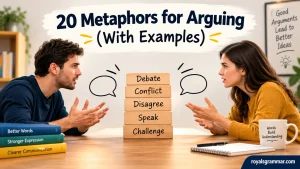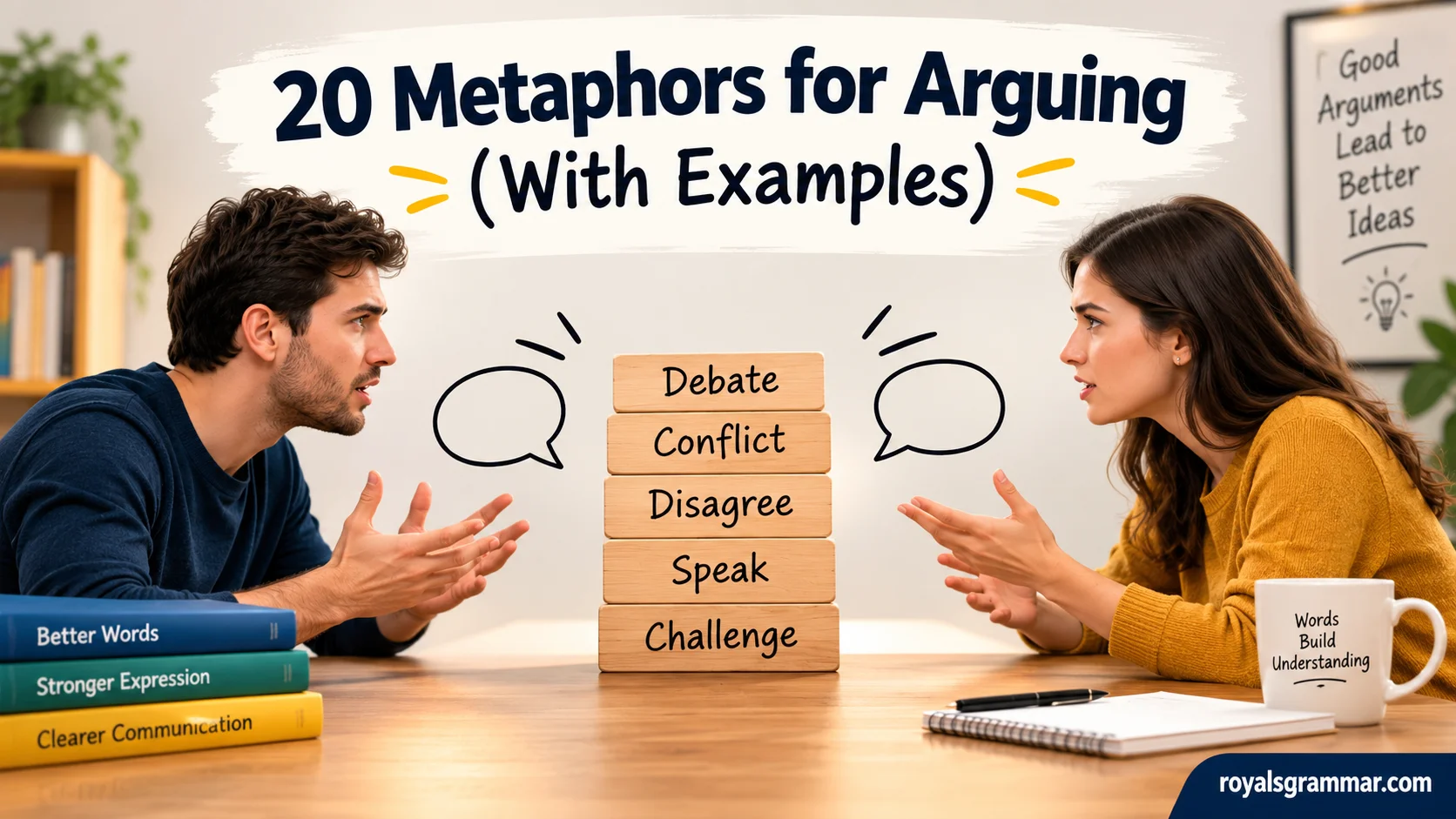
20 Metaphors for Arguing (With Examples) help writers explain disagreements through vivid comparisons, making difficult conversations easier to understand and remember. Metaphors for arguing help writers turn an ordinary argument into a powerful image that readers can see and feel. Through creative comparisons, a fight can become a battlefield, a storm, a fire, or a game of chess. These metaphors make conflict, tension, and emotional struggle easier to understand by turning an abstract conflict into a vivid scene. The right metaphor can transform ordinary words into memorable, stronger, and more emotionally meaningful expressions. Whether you’re creating a story, poem, essay, or speech, figurative language, imagery, and descriptive language can explain the meaning and intensity of a verbal conflict, dispute, debate, or verbal fight. Such powerful comparisons add depth to ordinary language, improve reading experiences, and make difficult ideas relatable and easy to understand.
Finding the right words during heated conversations, heated arguments, or a heated debate can help people communicate effectively without sounding harsh or insensitive. Arguments often involve feelings, emotion, frustration, emotional tension, and the struggle to understand opposing views. A simple metaphor can describe a tense moment, a difficult experience, or a simple argument with greater clarity, nuance, and consistency. In business communication, meetings, emails, formal writing, professional writing, formal communication, and persuasive speech, careful expressions and thoughtful word choice support clear expression, effective communication, and interpersonal communication.
Understanding context, interpretation, and meanings helps develop vocabulary, language skills, and vocabulary building while improving writing skills and creative writing. These literary devices can express emotional expression naturally, explain the intensity of conflict, and encourage constructive communication, constructive discussion, and conflict resolution. With simple explanations and practical examples, these metaphors show how to express disagreements and difficult conversations in everyday language and communicate thoughts thoughtfully to help people understand, manage disagreements, and reach an agreement.
1. A Battle of Words
Meaning: A disagreement in which two or more people strongly defend their opinions.
Explanation: A battle of words compares an argument to a fight in which people use language instead of physical force. Each person presents reasons, challenges opposing ideas, and tries to defend their position. This metaphor often describes intense disagreements where neither side wants to back down.
Examples:
- The meeting became a battle of words as both managers defended their decisions.
- Their dinner conversation turned into a battle of words over politics.
- What began as a simple discussion quickly became a battle of words.
3 other ways to say it:
- A war of words
- A verbal clash
- A battle of opinions
2. A War of Words
Meaning: A prolonged or intense verbal disagreement between people or groups.
Explanation: A war of words compares a serious argument to a war. Instead of weapons, the people involved use accusations, criticism, and strong statements to challenge each other. This metaphor is especially useful when describing public disputes, political disagreements, or ongoing conflicts.
Examples:
- The two politicians started a war of words during the televised debate.
- Their disagreement developed into a war of words on social media.
- The neighbors continued their war of words over the property boundary.
3 other ways to say it:
- A verbal battle
- A heated exchange
- An exchange of accusations
3. A Pressure Cooker
Meaning: A tense situation in which emotions build until an argument becomes difficult to control.
Explanation: A pressure cooker represents the emotional tension that develops when people keep their frustration inside. As irritation increases, even a small disagreement can trigger a major argument. This metaphor is particularly effective when describing families, workplaces, or relationships where unresolved problems have accumulated.
Examples:
- The office became a pressure cooker as deadlines approached and disagreements increased.
- Their relationship had turned into a pressure cooker after months of unspoken resentment.
- The family gathering felt like a pressure cooker waiting for someone to mention the sensitive topic.
3 other ways to say it:
- A powder keg
- A boiling pot
- A ticking time bomb
4. A Clash of Titans
Meaning: A major disagreement between two powerful, influential, or strongly opinionated people.
Explanation: This metaphor compares an argument to a confrontation between giants. It suggests that both sides have considerable influence, confidence, or expertise. A clash of titans is often used for business negotiations, political debates, sporting rivalries, and intellectual disagreements.
Examples:
- The debate between the two experienced lawyers became a clash of titans.
- Their business negotiations were a clash of titans, with neither executive willing to compromise.
- The television audience watched a clash of titans as the leading candidates challenged each other’s policies.
3 other ways to say it:
- A battle of giants
- A showdown between rivals
- A contest of strong opinions
5. A Tug-of-War
Meaning: An argument in which both sides struggle to persuade the other to accept their position.
Explanation: A tug-of-war compares disagreement to a game in which two teams pull in opposite directions. Each person wants the conversation to move toward their preferred outcome. The metaphor can describe negotiations, family disagreements, or conflicts in which neither side is ready to give ground.
Examples:
- The budget discussion became a tug-of-war between the finance team and the department managers.
- Choosing a holiday destination turned into a tug-of-war between the children and their parents.
- Their negotiation was a tug-of-war over price and delivery dates.
3 other ways to say it:
- A struggle for control
- A battle of wills
- A contest of opposing interests
6. A Verbal Boxing Match
Meaning: An argument in which people exchange sharp remarks and try to outsmart each other.
Explanation: This metaphor compares a conversation to a boxing match. Each statement acts like a punch, while a clever response serves as a counterattack. It often describes arguments in which participants focus more on winning than understanding one another.
Examples:
- The interview turned into a verbal boxing match when the journalist challenged every answer.
- The siblings engaged in a verbal boxing match over who had broken the vase.
- Their discussion became a verbal boxing match, with both sides trading sarcastic remarks.
3 other ways to say it:
- A war of words
- A battle of remarks
- A verbal sparring match
7. A Spark in a Powder Keg
Meaning: A small comment or disagreement that triggers a much larger argument.
Explanation: A powder keg represents a situation filled with hidden tension. A spark is all it takes to set it off. This metaphor explains why seemingly harmless words sometimes lead to explosive disagreements, especially when people have unresolved frustrations.
Examples:
- His careless joke was a spark in a powder keg of family tensions.
- The manager’s brief criticism became a spark in a powder keg during the already stressful meeting.
- Mentioning the old disagreement was a spark in a powder keg that reignited their conflict.
3 other ways to say it:
- The final straw
- A trigger for conflict
- The spark that ignited the argument
8. A Storm of Words
Meaning: A rapid and intense exchange of angry or emotional statements.
Explanation: A storm of words compares an argument to violent weather. Just as a storm can bring heavy rain, loud thunder, and strong winds, an intense disagreement can bring accusations, criticism, and emotional reactions. This metaphor helps readers imagine a conversation that feels overwhelming.
Examples:
- A storm of words filled the room after the unexpected announcement.
- She faced a storm of words when she questioned the team’s decision.
- Their calm discussion quickly became a storm of words as old frustrations resurfaced.
3 other ways to say it:
- A flood of accusations
- A torrent of criticism
- A whirlwind of angry remarks
9. Walking on Thin Ice
Meaning: Discussing a sensitive subject where a small mistake could lead to an argument.
Explanation: Walking on thin ice suggests that a person is in a risky situation. One wrong word or careless comment could break the fragile peace and trigger a disagreement. This metaphor is useful when describing delicate conversations with friends, family members, colleagues, or partners.
Examples:
- He was walking on thin ice when he brought up her recent spending habits.
- The supervisor knew he was walking on thin ice while discussing the employee’s performance.
- I felt like I was walking on thin ice when I asked my relatives about their disagreement.
3 other ways to say it:
- Treading carefully
- Entering dangerous territory
- Touching a sensitive nerve
10. A House Divided
Meaning: A group or family split by opposing opinions or beliefs.
Explanation: A house divided compares a group to a home whose members no longer stand together. The disagreement may involve politics, money, responsibilities, or personal values. This metaphor emphasizes how conflict can weaken unity and create distance between people who once shared common goals.
Examples:
- The family became a house divided after the inheritance dispute.
- The committee was a house divided over the proposed changes.
- Their political differences turned the organization into a house divided.
3 other ways to say it:
- A divided family
- A fractured group
- A split community
11. A Battle for the Last Word
Meaning: An argument in which each person insists on making the final statement.
Explanation: This metaphor describes disagreements driven by pride rather than problem-solving. Neither person wants to end the conversation without delivering one final remark. As a result, a minor issue can continue long after a reasonable solution is available.
Examples:
- Their discussion became a battle for the last word, with neither willing to walk away.
- The siblings turned a small disagreement into a battle for the last word.
- Instead of resolving the problem, they continued their battle for the last word.
3 other ways to say it:
- A contest of stubbornness
- A struggle for the final say
- A battle of egos
12. A War of Perspectives
Meaning: A disagreement caused by different ways of understanding the same situation.
Explanation: A war of perspectives compares conflicting viewpoints to opposing forces. Each person interprets events through personal experiences, beliefs, and expectations. The metaphor is useful because it shows that an argument does not always mean one person is entirely right and the other is entirely wrong.
Examples:
- Their discussion about education became a war of perspectives.
- The planning meeting turned into a war of perspectives over the company’s future.
- What looked like a simple misunderstanding became a war of perspectives between the two friends.
3 other ways to say it:
- A clash of viewpoints
- A conflict of opinions
- A disagreement in outlook
13. A Bridge on the Brink of Collapse
Meaning: A fragile relationship threatened by repeated arguments.
Explanation: A bridge connects two sides, just as communication connects people. When arguments repeatedly damage trust, that bridge becomes weaker. This metaphor emphasizes the importance of respectful language, listening, and honest communication before a relationship reaches a breaking point.
Examples:
- After months of accusations, their friendship was a bridge on the brink of collapse.
- Repeated arguments had turned their marriage into a bridge on the brink of collapse.
- The business partnership was a bridge on the brink of collapse after several unresolved disputes.
3 other ways to say it:
- A fragile connection
- A relationship hanging by a thread
- A bond close to breaking
14. A Snowball Rolling Downhill
Meaning: A small disagreement that gradually grows into a much bigger conflict.
Explanation: A snowball becomes larger as it rolls downhill, collecting more snow along the way. Similarly, an argument can grow when people introduce old complaints, misunderstandings, and unrelated frustrations. This metaphor explains how failing to address a minor problem early can make it harder to resolve later.
Examples:
- Their disagreement about chores became a snowball rolling downhill when they brought up old complaints.
- The misunderstanding was a snowball rolling downhill, growing more serious with every message.
- What started as a minor scheduling issue became a snowball rolling downhill into a workplace dispute.
3 other ways to say it:
- A growing conflict
- A problem spiraling out of control
- A minor issue turning into a major dispute
15. A Maze of Misunderstandings
Meaning: A confusing argument in which people struggle to understand one another.
Explanation: A maze has many turns and confusing paths. In the same way, an argument can become complicated when people make assumptions, misinterpret words, or fail to explain their intentions clearly. The metaphor highlights how careful questions and honest clarification can help people find a way forward.
Examples:
- Their conversation became a maze of misunderstandings after several messages were taken out of context.
- The contract dispute turned into a maze of misunderstandings between the two companies.
- Without clear communication, their disagreement became a maze of misunderstandings.
3 other ways to say it:
- A web of confusion
- A tangled disagreement
- A communication breakdown
16. A Wall Between Two People
Meaning: Emotional distance created by an argument or unresolved disagreement.
Explanation: A wall separates people physically, while this metaphor describes the emotional barriers that develop after conflict. Hurtful comments, distrust, and unwillingness to listen can make it difficult for people to reconnect. The expression can also suggest that honest communication may help remove the barrier.
Examples:
- Their argument built a wall between the two friends.
- Years of political disagreements had created a wall between the brothers.
- An honest apology helped break down the wall between them.
3 other ways to say it:
- An emotional barrier
- A gap in understanding
- A growing distance between people
17. A Flood of Accusations
Meaning: A situation in which one person receives many accusations in a short period.
Explanation: A flood can overwhelm everything in its path. Similarly, a person may feel overwhelmed when an argument turns into a series of accusations rather than a discussion about specific problems. This metaphor is especially useful when describing emotionally charged conversations.
Examples:
- He faced a flood of accusations after the project failed.
- The meeting became uncomfortable when she was met with a flood of accusations.
- Instead of discussing the mistake calmly, the team unleashed a flood of accusations.
3 other ways to say it:
- A barrage of criticism
- A torrent of blame
- A wave of complaints
18. A Battle of Egos
Meaning: An argument driven by pride, self-importance, or the desire to appear superior.
Explanation: A battle of egos occurs when people care more about protecting their pride than finding a solution. They may reject reasonable suggestions simply because they come from the other person. This metaphor is useful for explaining why some disagreements continue even when a compromise is possible.
Examples:
- The negotiation became a battle of egos instead of a discussion about the budget.
- Their disagreement was a battle of egos, with neither manager willing to admit a mistake.
- What should have been a simple apology turned into a battle of egos.
3 other ways to say it:
- A clash of pride
- A contest of arrogance
- A struggle for superiority
19. A Fork in the Road
Meaning: A disagreement that forces people to choose between different paths or decisions.
Explanation: A fork in the road represents a point where a person must decide which direction to take. In an argument, people may reach a moment when they must compromise, accept different opinions, or go their separate ways. Unlike metaphors that focus on anger, this expression emphasizes the decisions that follow a disagreement.
Examples:
- Their disagreement about moving abroad became a fork in the road for their relationship.
- The debate over company policy was a fork in the road for the management team.
- Their argument forced them to face a fork in the road and decide whether to rebuild their partnership.
3 other ways to say it:
- A turning point
- A crossroads
- A moment of decision
20. A Battlefield of Broken Promises
Meaning: A conflict shaped by disappointment, mistrust, and promises that have not been kept.
Explanation: This metaphor compares an argument to a battlefield filled with the damage left by past conflicts. Each broken promise can become another reason for frustration, making new disagreements harder to resolve. It is particularly effective when describing strained relationships or partnerships in which trust has gradually disappeared.
Examples:
- Their relationship had become a battlefield of broken promises after years of disappointment.
- The business partnership turned into a battlefield of broken promises when deadlines and agreements were repeatedly ignored.
- Their conversations felt like a battlefield of broken promises, with every new disagreement reopening old wounds.
3 other ways to say it:
- A landscape of broken trust
- A history of unresolved conflict
- A relationship damaged by disappointment
Exercise: Practice Metaphors for Arguing
Test your understanding of these metaphors with the following 15 multiple-choice questions (MCQs). Choose the most appropriate answer for each sentence before checking the answer key.
Multiple-Choice Questions
1. Two politicians exchange harsh statements during a public debate. Their disagreement is best described as:
A. A fork in the road
B. A war of words
C. A wall between two people
D. A maze of misunderstandings
2. A small disagreement about household chores grows into a major family conflict. Which metaphor fits best?
A. A snowball rolling downhill
B. A clash of titans
C. A fork in the road
D. A bridge on the brink of collapse
3. Two managers refuse to compromise because both want to prove they are right. This is:
A. A storm of words
B. A battle of egos
C. A maze of misunderstandings
D. A house divided
4. A sensitive conversation could easily trigger an argument if the wrong words are used. The person is:
A. Walking on thin ice
B. Winning a verbal boxing match
C. Facing a fork in the road
D. Building a bridge
5. A family is split into two opposing groups over an inheritance. This situation is:
A. A flood of accusations
B. A house divided
C. A battle for the last word
D. A clash of titans
6. People exchange angry statements rapidly during a heated meeting. Their conversation becomes:
A. A storm of words
B. A fork in the road
C. A fragile connection
D. A turning point
7. A minor comment triggers an argument in a room already filled with tension. The comment is:
A. A bridge on the brink of collapse
B. A spark in a powder keg
C. A battle of perspectives
D. A wall between two people
8. Two people continue arguing because neither wants to stop speaking first. They are engaged in:
A. A battle for the last word
B. A maze of misunderstandings
C. A house divided
D. A fork in the road
9. Two influential business leaders have an intense disagreement. This is best described as:
A. Walking on thin ice
B. A clash of titans
C. A snowball rolling downhill
D. A wall between two people
10. A relationship is threatened by repeated arguments and declining trust. It resembles:
A. A verbal boxing match
B. A bridge on the brink of collapse
C. A fork in the road
D. A flood of accusations
11. A person receives many accusations at once after a project fails. This is:
A. A flood of accusations
B. A battle of perspectives
C. A clash of titans
D. A maze of misunderstandings
12. Two colleagues interpret the same situation differently because of their experiences and beliefs. Their disagreement is:
A. A battlefield of broken promises
B. A war of perspectives
C. A verbal boxing match
D. A spark in a powder keg
13. A disagreement reaches a point where two partners must decide whether to continue working together. This is:
A. A storm of words
B. A battle of egos
C. A fork in the road
D. A pressure cooker
14. A conversation becomes confusing because people repeatedly misunderstand each other’s intentions. It is:
A. A maze of misunderstandings
B. A clash of titans
C. A battle for the last word
D. A house divided
15. A couple struggles because repeated promises have been broken and trust has disappeared. Their relationship is:
A. A tug-of-war
B. A battlefield of broken promises
C. A verbal boxing match
D. A storm of words
Answer Key
- B — A war of words: An intense verbal disagreement.
- A — A snowball rolling downhill: A small issue grows into a bigger problem.
- B — A battle of egos: Pride prevents the managers from compromising.
- A — Walking on thin ice: A sensitive situation that requires care.
- B — A house divided: A group separated by opposing views.
- A — A storm of words: A rapid, emotional exchange of statements.
- B — A spark in a powder keg: A small trigger causes a major conflict.
- A — A battle for the last word: Neither person wants to stop arguing first.
- B — A clash of titans: A major disagreement between powerful people.
- B — A bridge on the brink of collapse: A relationship is close to breaking down.
- A — A flood of accusations: Many accusations arrive at once.
- B — A war of perspectives: Different viewpoints create a disagreement.
- C — A fork in the road: A decision must be made about the future.
- A — A maze of misunderstandings: Confusion makes the disagreement difficult to resolve.
- B — A battlefield of broken promises: Past disappointments have damaged trust.
5 Frequently Asked Questions About Metaphors for Arguing
1. What is a metaphor for arguing?
A metaphor for arguing describes a disagreement by comparing it to something else, such as a battle, storm, or tug-of-war. For example, “Their discussion became a battle of words” compares a verbal disagreement to a fight.
2. What are some common metaphors for arguing?
Common metaphors include a war of words, a battle of egos, a tug-of-war, a verbal boxing match, and a storm of words. Each expression highlights a different aspect of disagreement, from competition to emotional intensity.
3. What is a metaphor for a heated argument?
A storm of words is a useful metaphor for a heated argument involving rapid, emotional statements. A verbal boxing match is another option when both people exchange sharp remarks or try to outsmart each other.
4. How do metaphors make descriptions of arguments more effective?
Metaphors make descriptions more vivid and memorable by helping readers visualize an abstract experience. For example, saying “Their disagreement became a pressure cooker” communicates rising tension more powerfully than simply saying “They were angry.”
5. Can metaphors for arguing be used in everyday conversations and writing?
Yes. You can use these metaphors in essays, stories, workplace discussions, speeches, and everyday conversations. Choose an expression that fits the situation, and avoid language that makes a sensitive disagreement sound more hostile than it really is.
Conclusion
Learning metaphors for arguing can help you describe disagreements with greater precision, creativity, and emotional awareness. Expressions such as a war of words and a verbal boxing match capture intense exchanges, while a maze of misunderstandings and a wall between two people highlight the confusion and emotional distance that arguments can create. Other metaphors, such as a fork in the road, focus on the choices people face after a disagreement.
The key is to choose a metaphor that reflects the situation accurately. Strong language can make your writing more engaging, but thoughtful wording can also encourage understanding rather than hostility. By practicing these 20 metaphors and their examples, you can strengthen your vocabulary and express complex disagreements in a more natural, vivid, and meaningful way.