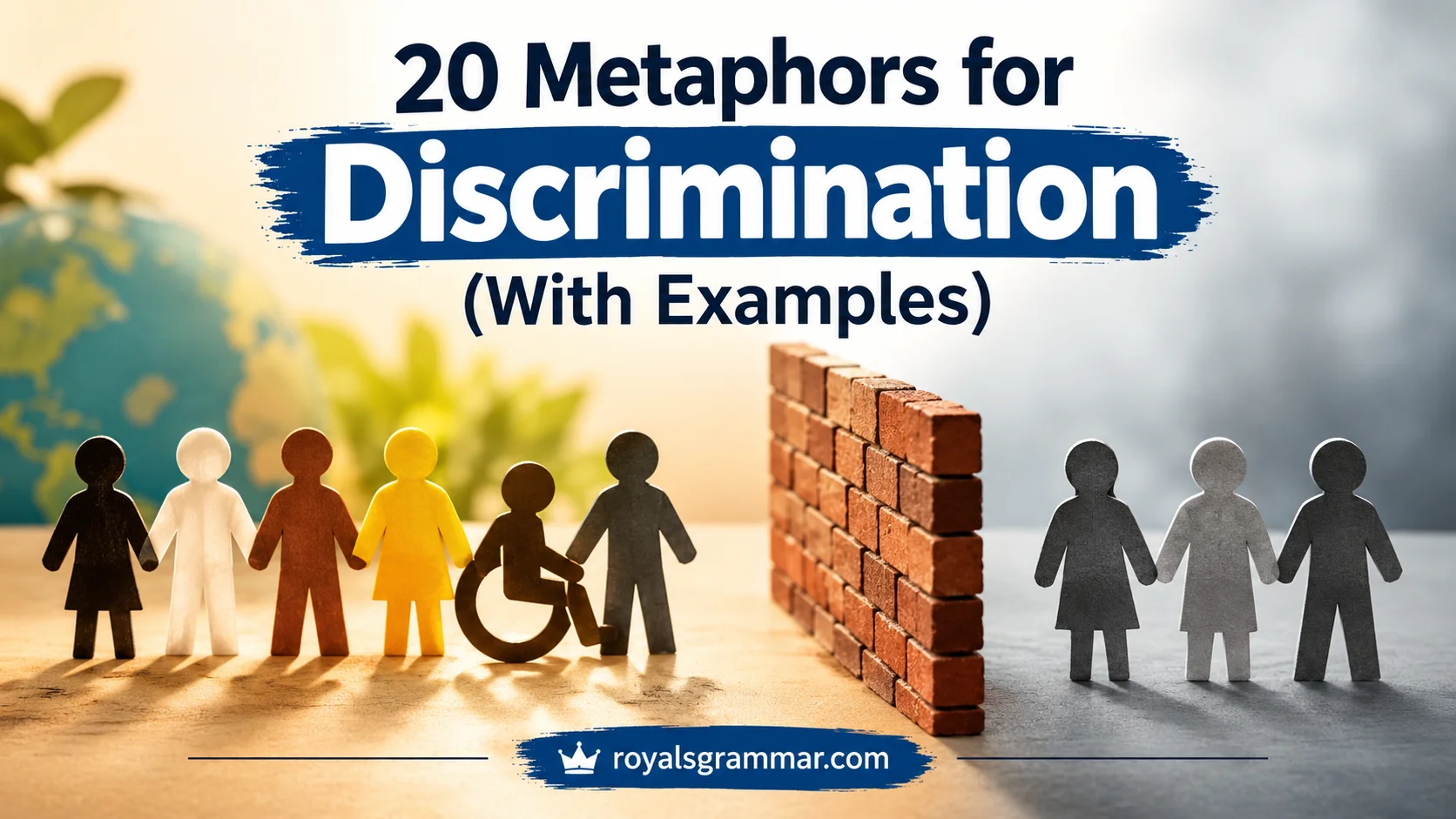
Metaphors for Discrimination (With Examples) use simple comparisons to make unfair treatment easier to understand. They help writers explain complex social issues with clear and vivid language. A metaphor for discrimination can show how barriers, unfair rules, and prejudice affect people. These helpful expressions can make an essay, speech, poem, or creative piece more emotional and meaningful. By using powerful images, writers can communicate the societal impact of discrimination and help readers understand difficult ideas through familiar examples.
Discrimination can sometimes hide behind closed doors, invisible barriers, or a shadow that follows people. A wall can represent exclusion, while a cage can show restricted freedom and limited choices. A stain can represent the lasting impact of prejudice and injustice. These metaphors help readers see and feel the effects of discrimination without relying only on literal descriptions. The right metaphor can transform an abstract idea into a clear, emotionally meaningful image.
1. A Wall Between People
Meaning: A barrier that separates people because of unfair judgment or prejudice.
Explanation: This metaphor compares discrimination to a wall that prevents people from connecting equally. The wall may represent stereotypes, prejudice, or unfair social rules that create distance between individuals or groups.
Example: “Discrimination built a wall between people who deserved the same opportunities.”
3 Other Ways to Say:
- A barrier between people
- A divide created by prejudice
- A fence separating communities
2. A Shadow Over Society
Meaning: A harmful problem that affects society and remains difficult to ignore.
Explanation: A shadow represents something negative that follows people and reduces their sense of safety, belonging, or fairness. This metaphor emphasizes the lasting presence of discrimination.
Example: “Discrimination remained a shadow over society, affecting people in many areas of life.”
3 Other Ways to Say:
- A cloud over society
- A stain on social harmony
- A dark presence in the community
3. A Locked Door
Meaning: An unfair barrier that prevents someone from receiving an opportunity.
Explanation: A locked door represents access that is available to some people but unfairly denied to others. It can describe barriers in education, employment, housing, or other areas.
Example: “Prejudice became a locked door between her and the opportunity she had earned.”
3 Other Ways to Say:
- A closed gate
- An obstacle to opportunity
- A barrier to progress
4. A Broken Bridge
Meaning: A damaged connection between people or communities.
Explanation: A bridge normally connects two places, so a broken bridge can symbolize relationships damaged by discrimination. It highlights how prejudice can prevent understanding and cooperation.
Example: “Years of unfair treatment left a broken bridge between the two communities.”
3 Other Ways to Say:
- A damaged connection
- A lost pathway
- A divided relationship
5. A Chain Around Opportunity
Meaning: Discrimination that restricts a person’s ability to move forward.
Explanation: A chain symbolizes restriction. When discrimination acts like a chain, it suggests that unfair treatment limits someone’s access to education, employment, recognition, or advancement.
Example: “Discrimination can become a chain around opportunity, holding capable people back.”
3 Other Ways to Say:
- A restraint on progress
- A barrier to advancement
- A limit on opportunity
6. A Blindfold on Justice
Meaning: A situation in which fairness is prevented by prejudice.
Explanation: Justice is often associated with impartiality. A blindfold in this metaphor represents a failure to see people fairly because stereotypes or prejudice influence decisions.
Example: “Prejudice placed a blindfold on justice, making equal treatment difficult.”
3 Other Ways to Say:
- A barrier to fairness
- A distortion of justice
- An obstacle to equality
7. A Crack in the Foundation
Meaning: A serious problem that weakens the basic principles of a community or institution.
Explanation: A building with a damaged foundation can become unstable. Similarly, discrimination can be described as a crack in the foundation of a society that values fairness and equal treatment.
Example: “Persistent discrimination is a crack in the foundation of an otherwise inclusive community.”
3 Other Ways to Say:
- A weakness in society
- A flaw in the social structure
- Damage beneath the surface
8. A Cage Without Bars
Meaning: A form of restriction that exists without visible physical barriers.
Explanation: A cage without bars represents limitations created through attitudes, stereotypes, exclusion, or unfair systems rather than physical confinement.
Example: “Constant prejudice created a cage without bars, limiting how freely he could pursue his goals.”
3 Other Ways to Say:
- An invisible barrier
- A hidden restriction
- An unseen limitation
9. A Stain on the Social Fabric
Meaning: Discrimination as a harmful problem that damages relationships within society.
Explanation: The social fabric represents the relationships and shared connections that hold communities together. A stain suggests that discrimination damages this collective harmony.
Example: “Unfair treatment can become a stain on the social fabric when it is allowed to continue.”
3 Other Ways to Say:
- A blemish on society
- Damage to social unity
- A mark on community life
10. A Weight on the Shoulders
Meaning: The emotional and social burden caused by discrimination.
Explanation: A weight on the shoulders symbolizes something that makes life more difficult. The metaphor focuses on the burden a person may experience when repeatedly facing prejudice or exclusion.
Example: “Repeated discrimination became a weight on her shoulders as she continued working toward her goals.”
3 Other Ways to Say:
- An emotional burden
- A heavy load
- A pressure carried daily
11. A Dividing Line
Meaning: An unfair separation between people based on identity or background.
Explanation: A dividing line separates one side from another. In discussions of discrimination, it can represent social attitudes or practices that place people into unequal categories.
Example: “Prejudice created a dividing line between neighbors who once worked together.”
3 Other Ways to Say:
- A social divide
- A line of separation
- A boundary created by prejudice
12. A Poison in the Well
Meaning: A harmful influence that affects an entire community or system.
Explanation: A well provides water for many people. If the water is contaminated, everyone who depends on it can be affected. This metaphor shows how discrimination can influence relationships, institutions, and opportunities.
Example: “Unchecked prejudice can become a poison in the well, affecting an entire community.”
3 Other Ways to Say:
- A harmful influence
- A contaminating force
- A problem spreading through society
13. A Closed Gate
Meaning: An unfair refusal to allow someone access or participation.
Explanation: A closed gate symbolizes exclusion. It can describe situations where people are prevented from accessing opportunities because of characteristics unrelated to their abilities or qualifications.
Example: “Discrimination can turn an open opportunity into a closed gate for certain people.”
3 Other Ways to Say:
- A blocked entrance
- An excluded pathway
- A denied opportunity
14. A Mirror Distorting Reality
Meaning: Prejudice that changes how people are perceived.
Explanation: A distorted mirror does not show an accurate reflection. Similarly, stereotypes can create a distorted picture of an individual instead of recognizing that person’s actual abilities and character.
Example: “Stereotypes can act like a mirror distorting reality, making people judge others before knowing them.”
3 Other Ways to Say:
- A distorted perception
- A false reflection
- A misleading image
15. A Fog Over Equality
Meaning: Confusion or prejudice that makes equal treatment difficult to recognize or achieve.
Explanation: Fog makes it harder to see clearly. This metaphor suggests that discrimination can obscure the principle of equality and make unfair treatment seem normal or difficult to identify.
Example: “Deep-rooted stereotypes created a fog over equality in the workplace.”
3 Other Ways to Say:
- A cloud over fairness
- Confusion about equality
- An obstacle to clear judgment
Read More: 20 Metaphors for Dying (With Examples)
16. A Tilted Playing Field
Meaning: A situation where people do not have equal conditions or opportunities.
Explanation: A playing field is expected to provide comparable conditions for everyone. If it is tilted, some participants have an unfair advantage while others face additional obstacles.
Example: “Discrimination can create a tilted playing field, making equal competition difficult.”
3 Other Ways to Say:
- An uneven field
- Unequal conditions
- An unfair starting point
17. A Shadow Blocking the Sun
Meaning: Discrimination preventing people from fully experiencing opportunity or belonging.
Explanation: The sun can symbolize hope, opportunity, and inclusion, while the shadow represents discrimination that prevents those positive experiences from reaching everyone equally.
Example: “Prejudice became a shadow blocking the sun, keeping opportunities out of reach for some people.”
3 Other Ways to Say:
- A barrier blocking opportunity
- A cloud over hope
- An obstacle to inclusion
18. A Thorn in the Path
Meaning: An unfair difficulty that makes someone’s journey harder.
Explanation: A thorn creates pain or difficulty along an otherwise accessible path. This metaphor can describe individual experiences of discrimination without suggesting that discrimination defines the person experiencing it.
Example: “Every unfair assumption became a thorn in his path toward professional success.”
3 Other Ways to Say:
- A painful obstacle
- A difficulty along the way
- A barrier to progress
19. A Broken Compass
Meaning: A loss of fairness or moral direction caused by prejudice.
Explanation: A compass helps people find direction. When it is broken, the traveler may move away from the intended path. Likewise, discrimination can represent a failure to follow principles of fairness and equal treatment.
Example: “When prejudice guides decisions, it is like using a broken compass.”
3 Other Ways to Say:
- A loss of moral direction
- A failure of fairness
- A misguided approach
20. A Chain Reaction of Exclusion
Meaning: One discriminatory action causing further barriers or disadvantages.
Explanation: A chain reaction begins with one event and produces additional effects. This metaphor shows how discrimination can continue through repeated decisions, attitudes, or social practices.
Example: “One unfair decision can trigger a chain reaction of exclusion that affects future opportunities.”
3 Other Ways to Say:
- A cycle of exclusion
- A sequence of unfair barriers
- A ripple of discrimination
FAQs:
1. What is a metaphor for discrimination?
A metaphor for discrimination describes unfair treatment through an imaginative comparison. Examples include “a locked door,” “a dividing line,” and “a tilted playing field.”
2. Why use metaphors when discussing discrimination?
Metaphors can make an abstract or difficult subject easier to visualize and understand. They can also help writers communicate emotional and social effects with greater clarity.
3. What is a metaphor for unfair treatment?
“A tilted playing field” is a useful metaphor for unfair treatment because it suggests that people are facing unequal conditions rather than starting from the same position.
4. What metaphor describes exclusion?
“A closed gate” is a clear metaphor for exclusion because it represents access being denied to someone who wants or deserves to enter.
5. Can these metaphors be used in essays?
Yes. These metaphors can be used in essays, speeches, articles, stories, presentations, and creative writing. Writers should choose an expression that fits the context and explain its meaning clearly.
Conclusion:
Metaphors can make difficult conversations about discrimination, prejudice, exclusion, and equality easier to understand. Expressions such as “a locked door,” “a tilted playing field,” and “a wall between people” help readers visualize how unfair treatment can affect individuals and communities. The most meaningful language is language that communicates the issue with clarity, empathy, and respect. When used carefully, these metaphors can strengthen essays, speeches, stories, and everyday discussions while encouraging thoughtful conversations about fairness and inclusion.












1 thought on “20 Metaphors for Discrimination (With Examples”